In a nutshell, long-term returns from stocks, exchange-traded funds (ETFs), or mutual funds are technically called compound earnings. However, it can still be calculated in the same manner if you know your expected rate of return. The effective interest rate (or effective annual https://www.personal-accounting.org/debit-memo-and-credit-memos-in-accounts-payable/ rate) is the rate that gets paid after all the compounding. When compounding of interest takes place, the effective annual rate becomes higher than the overall interest rate. The more times the interest is compounded within the year, the higher the effective annual rate will be.
Watch your balance double
This compound interest calculator is a tool to help you estimate how much money you will earn on your deposit. In order to make smart financial decisions, you need to be able to foresee the final result. That’s why it’s worth knowing how to calculate compound interest. The most common real-life application https://www.quickbooks-payroll.org/ of the compound interest formula is a regular savings calculation. Start by depositing $1,000 or a suitable amount in a high-yield savings account that earns 4% to 5% APY. Ally’s high-yield savings account currently earns 4.20% APY, but you can find savings accounts with rates as high as 5.55% APY.
How to Use the Compound Interest Calculator?
She graduated from the University of Texas at Austin with a bachelor’s degree in journalism, and has worked in the newsrooms of KUT and the Austin Chronicle. When not working, she is probably paddle boarding, hopping on a flight or reading for her book club. Founded in 1993, The Motley Fool is a financial services company dedicated dental bookkeeping to making the world smarter, happier, and richer. The Motley Fool reaches millions of people every month through our premium investing solutions, free guidance and market analysis on Fool.com, top-rated podcasts, and non-profit The Motley Fool Foundation. Simple interest is calculated only on the principal amount of an investment.
Compound Daily Interest Calculator
More frequent compounding periods means greater compounding interest, but the frequency has diminishing returns. This example shows the interest accrued on a $10,000 investment that compounds annually at 7% for four different compounding periods over 10 years. Start by entering your initial deposit or investment, or your current balance if you already have a deposit. Then enter how long you want to keep the deposit or investment, usually in years, but we also support other time periods. Note, that if you leave the initial and final balances unchanged, a higher the compounding frequency will require a lower interest rate. This is because a higher compounding frequency implies more substantial growth on your balance, which means you need a lower rate to reach the same amount of total interest.
Compound Interest Formula
Compare that to my previous savings account at my local credit union, which earned a paltry 0.01% APY. As a general rule, online-only banks consistently offer better APYs on savings accounts because they have fewer overhead costs than banks with physical branches. Assuming that the same 5% APY is applied to your new balance, you’d end up with $1,105 after the second year. This finance calculator can be used to calculate the future value (FV), periodic payment (PMT), interest rate (I/Y), number of compounding periods (N), and PV (Present Value). Each of the following tabs represents the parameters to be calculated. It works the same way as the 5-key time value of money calculators, such as BA II Plus or HP 12CP calculator.
Benefits of Using Compound Daily Interest
But if you have high-interest credit card debt, compound interest is working against you. There are various factors in the market that can influence the growth rate of an investment, thus making it difficult to interpret the year to yeargrowth. Consequently, the CAGR may be used to give a clarification on the progress of an investment.
This compound interest calculator can help you set goals and ensure you are on the right track. Gain – the difference between final balance and initial balance. The compounding of interest grows your investment without any further deposits, although you may certainly choose to make more deposits over time – increasing efficacy of compound interest. You should know that simple interest is something different than the compound interest. On the other hand, compound interest is the interest on the initial principal plus the interest which has been accumulated. It helps individuals make informed decisions about investing, borrowing, and planning for the future by providing accurate projections of how money will grow or diminish over time.
The following chart demonstrates the difference that the number of compounding periods can make for a $10,000 investment with an annual 7% interest rate over a 10-year period. Long-term investing can be a great way to save for your future.Use our compound interest calculator to see how your investments will grow over time. Compound interest occurs when interest is added to the original deposit – or principal – which results in interest earning interest. Financial institutions often offer compound interest on deposits, compounding on a regular basis – usually monthly or annually.
Note that the greater the compounding frequency is, the greater the final balance. However, even when the frequency is unusually high, the final value can’t rise above a particular limit. A compound interest calculator can help individuals estimate how much they need to save regularly to reach their retirement goals and ensure a comfortable financial future. As shown by the examples, the shorter the compounding frequency, the higher the interest earned. However, above a specific compounding frequency, depositors only make marginal gains, particularly on smaller amounts of principal.
- Calculate percentage additions and deductions with our handy calculator.
- In general, for savings accounts, interest can be compounded at either the start or the end of the compounding period (this is usually every month or every year).
- If your initial investment is $5,000 with a 0.5% daily interest rate, your interest after the first day will be $25.
- In that case, it will take about 30 years with an initial investment of $25,000 and an interest rate of 10% (compounded monthly).
- For this reason, lenders often like to present interest rates compounded monthly instead of annually.
In essence, our Finance Calculator is the foundation for most of our Financial Calculators. It helps to think of it as an equivalent to the steam engine that was eventually used to power a wide variety of things such as the steamboat, railway locomotives, factories, and road vehicles. There can be no Mortgage Calculator, or Credit Card Calculator, or Auto Loan Calculator without the concept of the time value of money as explained by the Finance Calculator. As a matter of fact, our Investment Calculator is simply a rebranding of the Finance Calculator while everything underneath the hood is essentially the same. The results of this calculator are shown in future value of the money. If you turn on the “Inflation (%)” option, then you can also see the adjusted for inflation value as well.
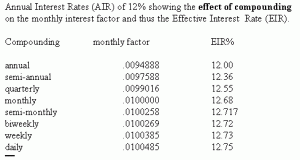
APY is a measure of how much your money will grow by in one year as a percentage of the initial amount. The number should be present on the account, allowing you to easily compare between options. If you want to make the inverse calculation, you can also use the savings calculator.
Financial experts have thoroughly vetted it to ensure it meets the practical needs of both individual investors and financial professionals. Have you ever wondered how many years it will take for your investment to double its value? Besides its other capabilities, our calculator can help you to answer this question. To understand how it does it, let’s take a look at the following example. In finance, the interest rate is defined as the amount charged by a lender to a borrower for the use of an asset.
Banks and credit unions can compound interest annually, monthly or daily. Most high-yield savings accounts compound interest daily and pay it out monthly. Stashing money in a high-yield savings account is a low-risk way to take advantage of compound interest and maximize the growth potential of your returns.